The New Path for Open Innovation in Public Sector and Education
For a long time, the expression “innovation in the public sector” has felt like a bit of an oxymoron. If you, like me, have spent any time navigating the enterprise tech landscape over the years, you know that the moment a project involves a school district, a university, or a government agency, the creative energy in the room instantly drops by about at least 80%. That’s just a fact. I even remember fellow colleagues saying “Oh, I would rather be in commercial than in Public Sector”.
It’s not because the people in those rooms lack vision and purpose (well, sometimes they do but that’s not the point). What I learned is that because Public Sector projects are mostly trapped in an architectural and regulatory straitjacket, they tend to start that creative process with a 1000lb iron ball tied to their heels, which end up limiting considerably the outcomes of “innovation”.
Don’t believe me? Go take a look at the specific battlegrounds where modern innovation usually goes to die and you will certainly find “highly regulated industries” in there (like education and the public sector in general).
If you have ever tried to build a Minimum Viable Product (MVP) or prototype a solution for a school district or a government agency, you know the pain. It is an environment historically characterized by extreme risk aversion, legacy vendor lock-in, and agonizingly long procurement cycles that average 12 to 18 months.
Let’s pick a real-world example: an engineering team trying to build a basic real-time attendance and safety-tracking app for a public school district. Before a single line of code can even be tested with a teacher, the project must clear hundreds of regulatory hurdles spanning data privacy laws like FERPA, GDPR and LGPD (if you are in Brazil) local state compliance frameworks, and rigid procurement checklists.
I did research on this very topic recently and found out that, according to data from the World Bank, a staggering 70% to 80% of public sector digital transformation projects fail to achieve their objectives or are entirely abandoned due to these bureaucratic and integration bottlenecks. In education, tech investments have historically lagged behind, with institutions spending less than 5% of their budgets on digital infrastructure. When security, data privacy, and compliance rules are tightly woven into the organizational fabric, rapid prototyping usually crawls to a halt. The result? Teams stop taking risks entirely, choosing safe, incremental updates over the meaningful changes our schools and civic institutions desperately need.
But what if we could bypass (or at least take a different look at) this bureaucratic stagnation entirely, without breaking a single compliance rule?
The Dream: Open Innovation and the 10x Moonshot
Imagine a world where that same public school district could test a hypothesis, build a fully functional prototype, and validate a concept with real teachers in days instead of fiscal quarters—all while maintaining absolute data compliance.
The dream of open innovation in these sectors isn’t about making 10% incremental improvements to ancient/legacy systems. It’s about taking a Moonshot approach. Pioneered by teams like Google X, Moonshot thinking challenges us to aim for 10x improvements rather than 10% optimizations. When you try to make something 10% better, you are forced to use the same tools, the same legacy architecture, and the same slow procurement procedures. But when you aim for a 10x improvement, you are forced to throw out the old playbook and invent an entirely new way of working.
Let’s land this idea with a concrete example. Let’s take the modern civic challenge (now in government): managing public housing maintenance requests. A 10% improvement would mean what? Building a slightly faster web form and moving it to the cloud? A 10x Moonshot would mean creating an autonomous ecosystem where conversational AI agents instantly triage maintenance requests, check current parts inventory via API, and automatically route work orders to the nearest technician’s mobile device, cutting response times from weeks to minutes.
Now, how do we make this? To make this 10x leap structurally possible in highly regulated sandboxes, we have to open up the innovation loop and be more sensible to new ways to get work done. We need an ecosystem where small, agile external teams, or even internal civil servants, can rapidly build and test lightweight, interoperable tools that address immediate community needs.
What I learned though is that the main obstacle has always been the sheer speed of development required to pull off a Moonshot. We haven’t had a software generation mechanism fast enough to match the scale of our ambitions/needs. Until now.
Riding the Wave of Vibe Coding (or, if you prefer, Agentic Coding)
This brings us to a radical new way of software production in the Public Sector that fits perfectly with the 10x Moonshot philosophy: vibe coding.
If you have spent any time on social media (especially Twitter or LinkedIn) or whatever other tech news channel recently, you have probably run across this phrase. Coined to describe the experience of building software by shifting your focus from manually writing syntax to directing autonomous AI models, vibe coding is the ultimate accelerator for hypothesis validation. You describe what you want in natural language, the AI generates the code, you test it, and you iterate based on the “vibe” and behavior of the output.
In the context of open innovation (and here I’m being purposefully very specific), vibe coding completely redefines the product design loop. Let’s go back to our public housing scenario discussed earlier. Under the old paradigm, testing an autonomous maintenance routing system required a three-month engineering sprint just to build a brittle mockup. With vibe coding, a product designer can sit down over a weekend, describe the system requirements to an LLM, and output a functional prototype that integrates live mock data.
By shrinking the time it takes to go from an idea to a working prototype from months to hours, vibe coding reduces the cost of speculative failure to practically zero and this is gold in an industry where the speculative failure is often used for political ends (which is another aspect that also kills innovation in this industry very frequently. But this is a whole different conversation). Fact is, it provides the hyper-velocity engine that Moonshot strategies have always needed to survive the initial ideation phase. Seems to be a perfect fit. And it works from that perspective (rapid innovation).
I’ve been personally involved in projects in Public Sector and Education where Time-To-Market (TTM) matters more than the product itself (I know, it seems crazy but it happens and for most scenarios, it makes total sense). I have also seen situations where the team involved in the conception of a given solution is so diverse in ideas and vision for that given product that only a rapid prototype was able to round things up before the next step. So, it works and we need it.
Now, not everything is about roses with vibe/agentic coding. If you just let raw, unguided AI engines churn out code in a public sector or education framework, you are looking at a catastrophic compliance failure. Imagine if that maintenance app we discussed suddenly hallucinates (and it happens a lot) an incorrect API call? It could, for instance, expose sensitive citizen data and a lot of people wouldn’t live to see another day 🙂.
So how do we capture this 10x velocity without creating a security nightmare?
The answer is straight (even risking to be superficial yet, as everything is super new and will evolve a lot in the coming months/years): From what I’ve seen so far, this responsible guardrail needed to achieve a good trade off between rapid prototyping and shipping real production code from vibe coding practices? A combination of Spec-Driven Development (SDD) & Agent Skills.
We need a responsible, engineer-guided framework to harness this speed safely. The magic happens when we combine the fluid, fast-paced nature of vibe coding with the rigid engineering discipline of Spec-Driven Development (SDD) and modular Agent Skills.
Ok, so let’s understand a bit better about what we are talking about when we cite those two concepts (sorry if you’re familiar with those concepts already).
What’s Spec-Driven Development (SDD)?
Instead of vaguely asking an AI to “build an app for public housing,” engineers define explicit, programmatic specifications up front. This includes writing the strict OpenAPI schemas, defining database constraints, and hardcoding security compliance boundaries into automated test suites. The AI agent is then given a specific, bounded sandbox where it can “vibe-code” it, but it is structurally blocked from violating the core specification.
In simpler words, it is a way to allow agents to code following strict rules defined by engineers. By doing this it is possible to reduce hallucinations, code duplications, security breaches, and a realm of other problems by simply letting “humans” define the rules in a structured way. Agents perform the heavy lift (generating code) while humans review what’s been produced and rearrange the rules of what should be done next.
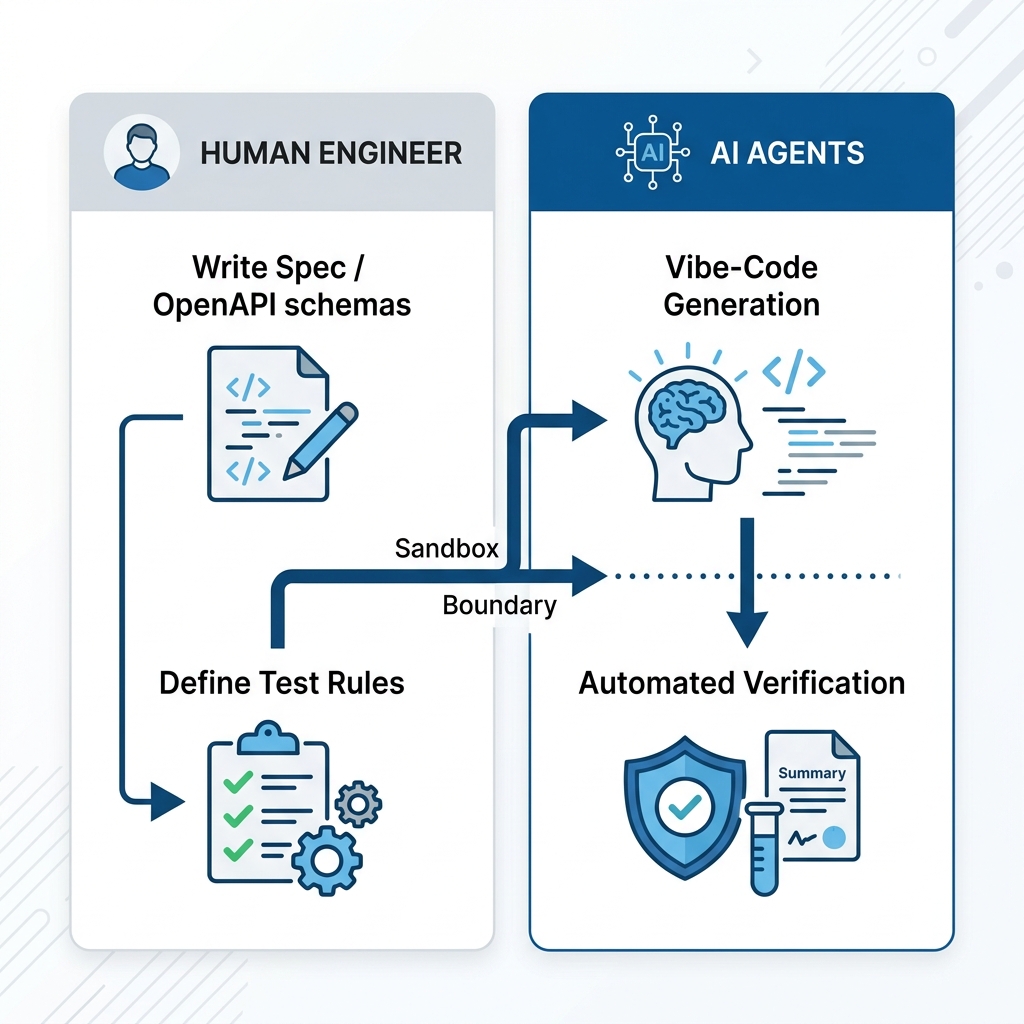
Furthermore, this helps us move away from treating AI as a single, generic chat window. Instead, we break the system down into autonomous agents equipped with distinct, specialized “skills.”
What about Agent Skills?
Well, here lies another very interesting and critical concept.
In the context of modern AI coding assistants (like Claude Code and Google’s Antigravity) and vibe coding practices, Agent Skills are modular, reusable playbooks or “instruction sets” that tell an AI agent exactly how to execute specific, complex engineering tasks.
Instead of forcing you to provide massive amounts of context, rules, and commands in every single prompt, a skill functions like a specialized recipe card. It is typically defined using a standard framework (often a SKILL.md file with YAML metadata) that a coding agent discovers and loads on the fly.
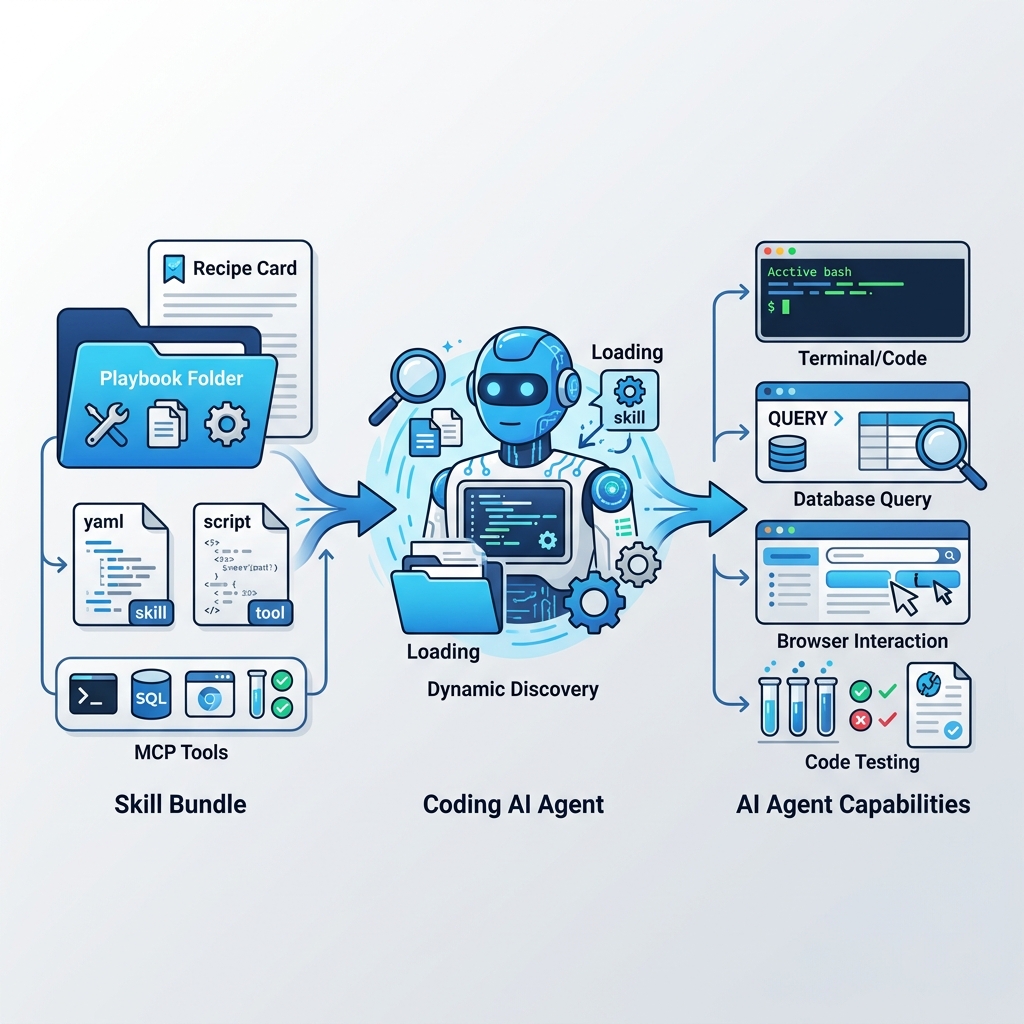
As far as I have seen, agent skills generally fall into two categories:
- Static Skills: Pure prompt-engineering frameworks that guide the agent’s judgment (for instance: enforcing a specific code style or security architecture checklist).
- Dynamic Skills: These are playbooks coupled with executable scripts or Model Context Protocol (MCP) servers, giving the agent the ability to interact with databases, run automated tests, use a browser to inspect a frontend UI, or trigger a deployment API.
Why are Agent Skills so critical to building reliable code? Well, without agent skills, vibe coding risks (and eventually will) turning into a high-speed game of “prompt and pray,” where the AI generates a wall of code that looks correct but fails silently in production.
Agent skills introduce reliability through several key mechanisms like shifting from “Text Generation” to “Closed-Loop Verification”, which changes the AI’s role from a passive writer to an active, self-correcting engineer. It also prevents a super common problem when typing long and multiple prompts, known as “Prompt Fatigue”. As a codebase grows, an AI agent’s context window fills up with thousands of lines of code, log histories, and conversational context. If you try to manage code rules purely through conversation, the agent will eventually suffer from attention decay and start hallucinating or cutting corners.
It also allows us to enforce standard engineering workflows which end up translating in code that relies on strict compliance with architectural patterns. By applying specialized skills, we can ensure the AI behaves deterministically.
The Modular AI Agent Architecture
To orchestrate this at an enterprise scale we combine those two techniques just discussed with the deployment of a multi-agent framework where each agent has a specific job within the runtime environment. The set up I’ve been working with in Google Antigravity for most of the cases where I’m vibe coding relies on three main agents. They are:
- Planner Agent: Receives the human engineer’s high-level intent and aligns it against the master specification. It has pre-determined skills to allow it to perform its planning tasks compliantly.
- Executor Agent: The heavy lifter. Handles the vibe coding itself, rapidly generating the components, routes, and UI blocks. Also relies on a strong specification and set of skills to perform their job at best.
- Supervisor/Memory Agent: Performs continuous verification. It runs the generated code against the automated test suites, ensuring that data encryption, data management (FERPA, GDPR, LGPD) rules, or local privacy boundaries are completely uncompromised. Again, strict specs and very specific skills are added here.
Obviously, depending on the complexity and size of the project, more agents can be added to the fleet with specific specs and skills. That’s the beauty btw, the process is far from being rigid and static (just like human-based development ecosystem also isn’t).
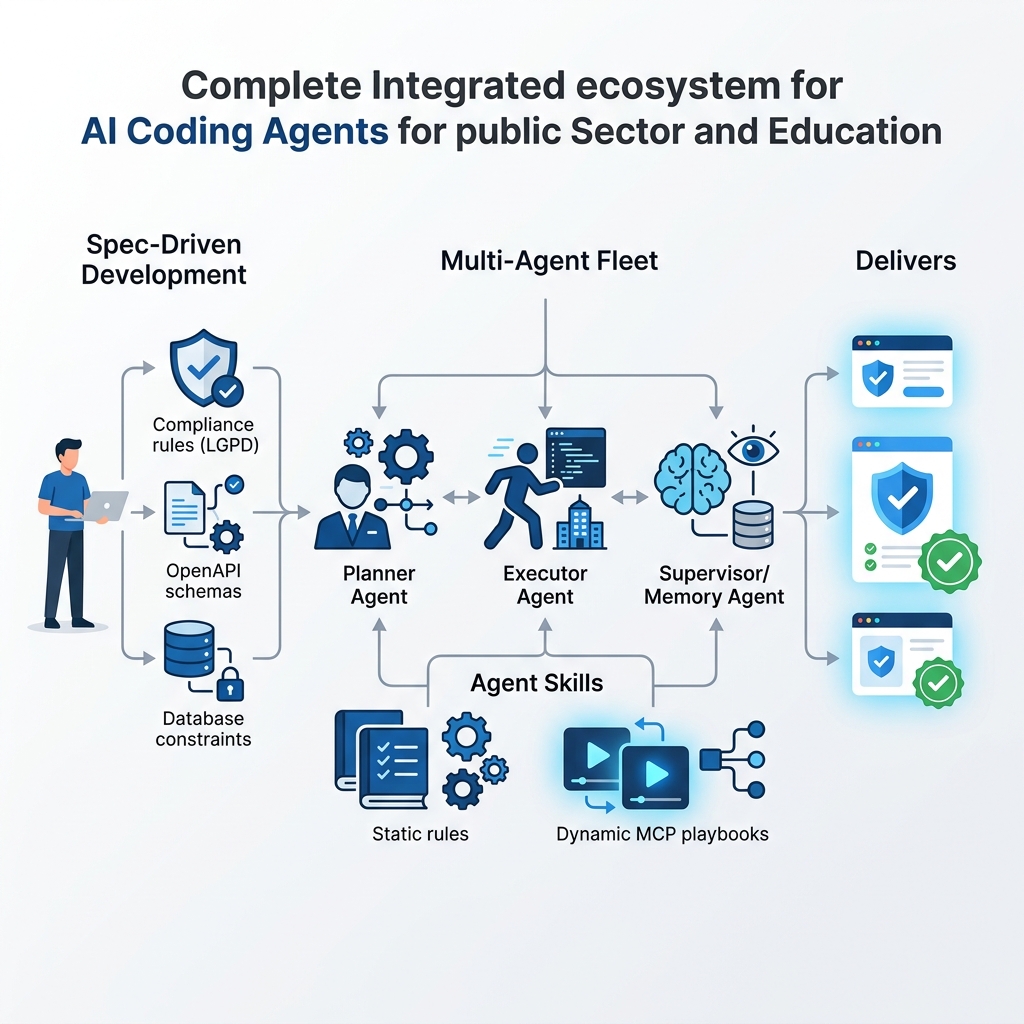
What I quickly learned by utilizing this new working architecture, is that the developer no longer needs to spend their day writing boilerplate code. No. Instead, each developer now becomes the coordinator of the fleet, they write the rules of the stadium, and let the specialized agents play the game. They’re still solving problems (that’s what engineers do, right?!), just in a different way.
The Shifting Role of the Software Engineer
I want to take this opportunity and provide a very personal view on this very topic. It is obvious, as mentioned above, that this paradigm completely flips the traditional software engineering career path on its head. For decades, engineers spent 80% of their time wrestling with syntax, debugging memory leaks, and managing build pipelines. I’ve been there and you, reading this article have probably been there too.
With the infusion of deep AI orchestration, in my humble opinion, the modern engineer is transitioning from a line-by-line builder into a systems conductor and an enterprise architect. The primary value they will deliver to an organization is no longer that strong muscle memory for programming language syntax; it is their deep understanding of domain-driven design, data modeling, and security vectors.
I went to see what research institutes had to say and I found out that the numbers back this up. Gartner predicts that by 2028, 75% of enterprise software engineers will use AI assistants to co-create code, up from less than 10% in early 2024. Google is a big example of this shift as Sundar Pichai announced at I/O this year that 75% of all code written at Google is already via AI. That’s massive!
My view is that the engineers who will be successful in the future will be those who know how to design the perfect spec and guide autonomous agents to fill in the blanks. In a 10x Moonshot culture, the engineer becomes the ultimate filter of quality, ensuring that the velocity of vibe coding is matched by the rock-solid stability of elite system architecture.
But as compelling as this future sounds, we cannot afford to look at it through rose-colored glasses. Moving at 10x speed with AI agents introduces a brand new set of operational risks that every CIO and CTO must prepare for.
The new software engineer will be more critical than ever, it just needs to be looked at from a different lens.
Weighing the Balance: Enterprise Pros and Cons
When you introduce this level of automated velocity into highly regulated environments like Public Sector and Education, you are inherently trading certain traditional certainties for speed. No discussion about that. So, to me, it seems to be pertinent to have an honest look at the balance sheet and see what comes out of it.
Advantages
- Hyper-Velocity Prototyping: Accelerates time-to-market for public sector MVPs by up to 10x, allowing public servants and its partners to respond to crises, legislative changes and deliver new value to citizens and students much faster.
- Possible Radical Cost Reduction: In the context of open innovation and considering solely the aspect of hypothesis validation, it tends to drastically lower the capital expenditure required to test speculative civic or educational products. Even considering the cost of tokens in that process.
- Empowered Domain Experts: Not only allows but mainly empowers product managers and educators to participate directly in the design loop, ensuring the software solves real human problems and is not a fantasy created by someone disconnected from the reality in which that product/solution will live.
Disadvantages
- Possible Architectural Drift: As we discussed exhaustively through the course of this article, if left unchecked, continuous AI code generation can lead to a messy, fragmented codebase that is difficult to maintain long-term. More than just that, it can lead to serious compliance and security issues, risking the public image of organizations. So it needs to be done properly.
- Hidden Vulnerabilities: AI models can easily replicate subtle security bugs or outdated patterns if the underlying training data or prompt guardrails are weak. Again, we need engineers in the control plane here.
- Compliance Hallucinations: An unguided agent might generate a solution that visually looks perfect but silently violates strict data containment policies and that is too common (meaning it happens a lot) to be left deeply unchecked.
Mitigating Risks at the Enterprise Level in Production
To adopt this approach safely within a regulated enterprise framework, I would like to leave a few recommendations (there are probably more but these are the most critical ones I’ve seen thus far) organizations should implement towards mitigating risks with this approach to product development.
- Automated Compliance Gates: Integrate automated static analysis tools (SonarQube, Snyk Code, among others) into the CI/CD pipeline that instantly reject any AI-generated code violating pre-defined security or privacy baselines. This, lined up with strict specs when the code is being cooked, will reduce the surface of problems dramatically while still allowing teams to create rapidly.
- The “Human-in-the-Loop” Review Protocol: This is mandatory. Organizations adhering to the world of agentic coding must maintain a strict requirement that all agent-generated code must pass a peer review conducted by a senior engineer before moving past a sandbox prototype.
- Immutable Core Spec Registries: Organizations must ensure that system boundaries and database schemas remain strictly managed by senior human architects, treating them as immutable laws that the AI agents are structurally incapable of altering. These must directly affect the specs provided by engineers to coding agents.
I strongly believe that by combining the 10x ambition of Moonshot thinking, the lightning-fast creativity of vibe coding, and the absolute rigor of spec-driven engineering, both public sector and education sectors can finally unlock the true potential of open innovation and unleash unseemed impact in society. Yes, we can build solutions that are not only remarkably fast but profoundly reliable.