Career Update: I'm Now a Chief Architect at Google
If you have been reading my blog for a while, you might remember an article I wrote back in 2023 about my life as a Brazilian living and working in the US. In that post, I opened up about how terrified I was when I decided to leave Microsoft after almost ten years, where I was completely adapted, comfortable, and had a solid delivery track record, to join Google Cloud back in 2021.
I remember walking into Google’s office in São Paulo and New York with that classic mix of excitement and deep insecurity in my stomach, wondering: “Can I actually pull this off here?”
Well, fast forward five years.
A few days ago, I received the official confirmation that I have been promoted to Chief Customer Architect at Google Cloud for Education and Public Sector’s customers, after five intense, challenging, and deeply rewarding years serving as Principal Architect in the same organization.
I’m not gonna lie to you: the moment the news sank in, it hit me the exact same way that Thursday night email did back in 2018. That overwhelming wave of emotions. Gratitude, pride, relief, and, yes, let’s be completely honest, a brand-new dose of butterflies in my stomach (if your next career step doesn’t scare you at least a little bit, it probably isn’t big enough, right? :)).
Looking back at the kid from the countryside of Brazil who burned out in 2015 working 16-hour days, had to re-learn how to speak business English from scratch, and started over in a new country, reaching an executive architecture role at a company like Google feels surreal. Only thinking about the journey with my wife Angie and our little boy Ben makes me emotional.
Why am I sharing all this with you today?
Not to brag about a title. Titles come and go, and at the end of the day, they are just labels on LinkedIn. I’m writing this because over the past few years, I have worked with and mentored dozens of brilliant software engineers, cloud architects, and technical leaders who feel “stuck” in their careers. People who work tirelessly, master every new framework, and deliver rock-solid code, yet keep hitting an invisible ceiling when trying to break into Staff, Principal, Distinguished, or Chief Architect levels.
So, in this article, I want to pull back the curtain. I want to share what this transition feels like from the inside, highlight the critical organizational realities that engineers in Big Tech companies like Google need to be aware of, and leave you with a set of practical, data-backed advices (they helped me a lot, I hope they can help you too) if you are currently in the pursuit of your next big career leap.
What Does It Really Feel Like?
When I spent my last five years acting as Principal Architect for Education and Public Sector, I had the privilege of being on the frontlines of two massive paradigm shifts: the maturation of cloud-native data platforms and the explosive arrival of Generative and Agentic AI. Together with an incredible group of Google Cloud Customer Engineers and visionary customers, we didn’t just talk about slideware; we built real, open-source solutions that impacted millions of students and citizens, like the Education Data Platform (EDP) and AIRA (Artificial Intelligence Reading Assessor), which helped governments like the State of Paraná in Brazil fight functional illiteracy at scale. Just to mention a few.
When you get promoted after years of pouring your soul into work like that, the first feeling is validation. Not validation of your ego, but validation that taking risks in “hard, unglamorous industries” (remember when I wrote about how Public Sector and Education start every innovation race with a 1,000lb regulatory iron ball tied to their heels?) actually matters.

The second feeling, which arrives about 48 hours after the celebration dinner, is a profound shift in gravity.
For the past twenty years of my career in tech (yes, I’m getting old, I know), a huge part of my identity was tied to being the person in the room who could solve the hardest technical puzzle. As you step into a Chief Customer Architect seat, you realize very quickly that the nature of the game has fundamentally changed. You are no longer evaluated simply by the elegance of a single system architecture you designed yourself. You are evaluated by how effectively you can align C-suite business strategy with multi-year technological transformation, de-risk massive enterprise investments, and elevate the technical bar of entire ecosystems around you.
As executive coach Marshall Goldsmith famously summarized in his seminal book, “What Got You Here Won’t Get You There”: the very habits of deep, heads-down, deterministic individual execution that propel an engineer from Junior to Senior—and even to Staff—can actually become the exact bottleneck that prevents you from reaching Principal or Chief Architect scope.
What Engineers in Organizations Like Google Need to Be Aware Of
There is nothing better than backing up assumptions with actual data and research. After all, as W. Edwards Deming once said, “In God we trust; all others must bring data.” So let’s look at the structural realities of how senior technical careers actually work inside large engineering organizations like Google.
If you are in an engineering or architecture track/orgs today, here are four non-obvious truths you must internalize.
1. Technical Brilliance is Only “Table Stakes”
Let’s be realistic for a second. When you work at a company like Google, Microsoft, or AWS, everyone around you is smart. Everyone knows how to design a distributed microservices architecture, everyone understands Kubernetes, and everyone can talk about LLM context windows and RAG pipelines. Often, even more than you! :)
Recently I got to learn that early in Google’s history, many engineers believed that technical superiority was the only thing that mattered in leadership. In fact, Google ran a famous multi-year people analytics study called Project Oxygen to prove whether managers and senior leaders even mattered, and what separated the highest-performing leaders from the rest.
Guess what the data showed? Out of the 10 key behaviors of Google’s best leaders identified by Project Oxygen, technical skills ranked #8. What ranked at the top? Being a good coach, empowering the team without micromanaging, creating an inclusive environment of psychological safety, and having a clear vision and strategy for the team.
Similarly, Google’s Project Aristotle, which analyzed 180+ engineering and sales teams across the company, proved that having a room full of “rockstar” individual contributors did not correlate with team effectiveness. Instead, the five pillars of elite execution were Psychological Safety, Dependability, Structure and Clarity, Meaning, and Impact.
Why am I telling you this? Because if your career growth strategy is “I am going to be 10% more technical than my peers and collect five more cloud certifications,” you are playing a losing game with diminishing returns. At senior engineering levels, deep technical competence is the entry ticket to the stadium, not the trophy.
2. The Ride That Matters: “The Architect Elevator”
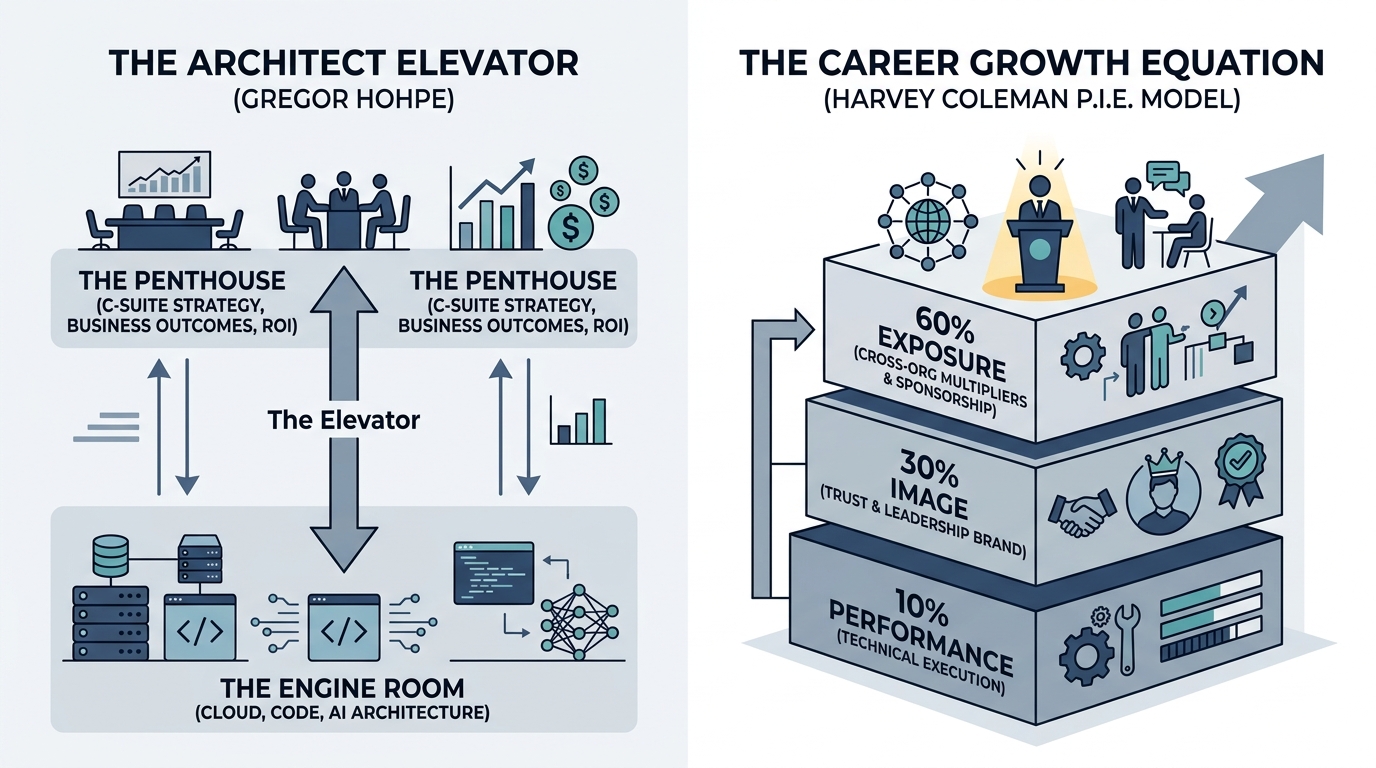
One of the best mental models ever written for senior technologists, and which I find incredibly accurate, comes from Gregor Hohpe (who, not coincidentally, spent years as a Principal Architect at Google Cloud) in his book “The Software Architect Elevator: Redefining the Architect’s Role in the Digital Enterprise”.
Hohpe argues that modern enterprise organizations are like high-rise skyscrapers:
- In the Penthouse, C-level executives (CEOs, CFOs, CIOs, Ministers of Education) define business strategy, budget allocation, risk appetite, and revenue targets.
- In the Engine Room, engineering teams wrestle with CI/CD pipelines, VPC service controls, database latency, and agentic tokenomics.
In 90% of organizations, the elevator between these two floors is broken. Executives complain that engineering is a slow, expensive black box; engineers complain that executives live in a fantasy land of unrealistic deadlines.
“In an organization like Google Cloud, a Principal or Chief Customer Architect is the person who rides that elevator up and down every single day, translating technology constraints into business strategy on the way up, and translating business vision into actionable engineering architecture on the way down.”
Last year, when I completed my Professional Master’s / MBA in CTO and Innovation at The Wharton School (UPenn), this clicked for me in a completely new way. If you walk into a meeting with a hospital CEO or a university provost and start talking about Pub/Sub throughput or vector embeddings, you have already lost the room. Conversely, if you walk into a room of Staff Engineers and only talk about high-level “synergies” without being able to open an IDE or review a system specification, you lose all technical credibility. You have to master both floors.
3. The P.I.E. Equation: Why Performance Alone Is Only 10% of the Game
Here is a hard truth that usually makes engineers uncomfortable at first. In his landmark corporate study published in “Empowering Yourself: The Organizational Game Revealed”, Harvey J. Coleman quantified the three elements that drive career advancement inside large organizations, known as the P.I.E. Model:
- Performance (10%): The quality of your day-to-day execution and technical delivery.
- Image (30%): What other people think of you—your personal brand, reliability, executive presence, and whether you are seen as a collaborative problem-solver or a difficult “brilliant jerk.”
- Exposure (60%): Who knows about you and your work—both inside your immediate management chain and two levels above and across adjacent organizations.
Wait, “Fabricio, are you telling me that actual work only matters 10% and the rest is corporate politics?!”
Calm down! Let me explain what Coleman actually means by that, especially in an engineering-driven culture like Google.
Performance is only 10% of the differentiator at promotion time because 100% of the candidates sitting in the promotion calibration pool are very likely to have stellar performances. If you don’t have the 10% (rock-solid delivery), you don’t even get nominated. Once you are in that pool, however, what separates the engineer who gets promoted to Principal or Chief Architect from the one who gets deferred for another year is Image (do people trust your judgment in high-stakes moments?) and Exposure (did the architecture, codebase, or framework you built scale beyond your immediate squad to move the needle for the broader organization?).
It is your job to help your manager make your management chain know about the impact of the work you’ve been driving/leading/delivering.
4. The Scope Progression: How the Expectations Actually Shift
To make this concrete, let’s look at how the expectations evolve across the senior technical track. Drawing from Will Larson’s industry-standard research on Staff+ engineering archetypes in “Staff Engineer: Leadership Beyond the Management Track” and staffeng.com, as well as DORA’s (DevOps Research and Assessment) studies on socio-technical systems, here is how the lens shifts as you climb:
| Dimension | Senior / Staff Architect | Principal Architect | Chief Customer Architect |
|---|---|---|---|
| Primary Scope | Single project, workload, or customer deployment. | Industry vertical, regional portfolio, or multi-team technical domain. | Enterprise-wide C-suite strategy, global/cross-industry transformation, and executive advisory. |
| Problem Nature | Well-defined: “How do we design and deploy this specific system reliably?” | Ambiguous: “What should our technical strategy and reusable solutions be for this entire sector?” | Existential & Strategic: “How do we transform the customer’s business model while protecting core economics?” |
| Success Metric | System uptime, successful go-live, clean architecture. | Ecosystem adoption, repeatable IP (e.g., open-source platforms), cross-team velocity. | Long-term C-suite trust, multi-year strategic partnerships, industry-level market shifts, and ARR/ROI impact. |
| Communication Lens | Engineering Leads, Product Managers, Technical Teams. | Directors, VPs of Engineering, Industry Leaders. | CEOs, CIOs, CTOs, CFOs, Boards, and Internal Executive Leadership. |
Notice the pattern? As you move to the right of that table, your job shifts from solving problems that are handed to you, to discovering and framing the problems that nobody else has properly articulated yet.
6 Practical Advices for Those in the Search of Career Growth
Okay, Fab. Theory is great, and understanding how the machine works is helpful. But what should I actually do on Monday morning if I am aiming for my next promotion or looking to step up into a Principal or Chief Architect role?
Mirroring the structure I shared when planning my move to the US, here are six practical, battle-tested strategies that made all the difference in my own journey over the past five years at Google Cloud.
1. Act at the Next Level Before You Get the Title (Always Keep a “Brag Document”)
In Big Tech organizations, promotion committees are inherently conservative: they are designed to minimize false positives. That means promotions are lagging indicators, not leading ones. You are almost never promoted based on potential; you are promoted when there is undeniable, sustained evidence (usually over 12 to 24 months) that you are already operating at the next level.
Read the official leveling rubric for the role above yours and do an honest gap analysis. Where are your blind spots? Is it cross-org influence? Public thought leadership? Executive business cases?
And please, do yourself a favor: don’t wait until performance review week to remember what you did six months ago. Adopt Julia Evans’s famous engineering practice of maintaining a living “Brag Document”. Every two weeks, write down not just what you built, but the measurable delta: how much customer revenue it unlocked, how many engineering hours your reusable asset saved across other teams, or what executive decision your architecture paper changed. Remember Deming: bring the data!
2. Turn Mentors into Sponsors
In my previous article on moving to the US, I talked a lot about having career mentors. Mentors are invaluable—they help you see your blind spots and give you honest feedback. But as you reach senior engineering levels, a mentor alone is not enough. You need Sponsors.
Carla Harris, Vice Chairman at Morgan Stanley and author of “Expect to Win”, explains this brilliantly in her famous TED Talk on how to find the person who can help you get ahead at work. In any organization, promotion decisions happen behind closed doors in calibration committees where you are not present.
- A mentor is someone who talks with you privately to give you advice.
- A sponsor is a senior leader sitting inside that calibration room who uses their own political and relationship currency to talk about you and fight for your promotion when the door is closed.
Research by economist Sylvia Ann Hewlett published in the Harvard Business Review (“The Sponsor Effect”) found that professionals with active executive sponsors are 23% more likely to move up in their career than peers without one, yet the vast majority of technical professionals over-invest in mentorship and under-invest in sponsorship. How do you earn a sponsor? By delivering outsized Performance Currency on a priority they care deeply about, and building Relationship Currency by making their broader organization successful.
3. Become a “Force Multiplier,” Not a Heroic Bottleneck
Many engineers secretly love being the “firefighter hero”, the one person who knows the undocumented legacy system inside out and swoops in at 2 AM to save the day. Here is the trap: if you are irreplaceable in your current seat, you are unpromotable to the next one.
In her research book “Multipliers: How the Best Leaders Make Everyone Smarter”, Liz Wiseman studied over 150 leaders across global industries and found that “Multiplier” leaders get nearly 2x more capability and output from the people around them compared to “Diminishers” (who centralize knowledge and try to be the smartest person in every room).
At Google Cloud, the biggest inflection point in my Principal Architect journey happened when we stopped treating customer architectures as one-off, bespoke consulting engagements and started turning them into open-source, reusable ecosystems—like EDP and AIRA. When you build a tool, a reference architecture, an Agent Skill, or a playbook that empowers 50 other architects across Latin America, North America, and Europe to close deals and deploy faster without you needing to be on every single call, you stop being an individual contributor and become a true Force Multiplier.
4. Master Executive Storytelling and Unit Economics
We are living through an unprecedented transformation in software engineering. As I cited in my recent article on Open Innovation, Gartner predicts that by 2028, 75% of enterprise software engineers will use AI coding assistants, and Sundar Pichai shared that a massive share of new code at Google is already AI-assisted. Meanwhile, the World Economic Forum’s Future of Jobs Report 2025 ranks analytical thinking, systems thinking, leadership, and social influence alongside AI and big data as the most critical skills of the decade.
What does that mean for your career? It means that raw syntax generation is rapidly becoming a commodity. What cannot be commoditized is business judgment and executive storytelling.
If you want to grow into a Principal or Chief Architect role, invest heavily in learning business fundamentals. That is the exact reason I went back to school at Wharton after 20 years in tech. Learn how to read a balance sheet. Understand how cloud consumption and agentic tokenomics affect gross margins. Learn how to structure a 3-Horizon investment roadmap. When you can sit across from a CTO or a CFO and defend a technical architecture using their economic language, you immediately put yourself in the top 1% of engineering talent.
5. Run Toward the Messiest, Most Ambiguous Problems
Remember at the beginning of my Open Innovation post when I mentioned colleagues saying, “Oh, I would rather be in commercial than in Public Sector” because Public Sector and Education were too hard, too bureaucratic, and too slow?
Looking back, leaning into Education and Public Sector was the best career decision I could have made. Why? Because career-defining promotions do not happen in comfortable, pre-solved territories. They happen in the messy, ambiguous, high-friction spaces where nobody has written the playbook yet.
According to Gartner’s research on high-impact Enterprise Architects, the architects who advance to executive leadership are those who proactively bridge organizational silos, stepping into the gap between Product, Engineering, Compliance, and Go-To-Market when a strategic initiative is stalling. Don’t wait for your manager to assign you a neatly packaged Jira ticket. Look for the “1,000lb iron ball” that is slowing down your customers or your org, rally a cross-functional coalition of volunteers, build a rapid prototype to prove what is possible, and own the outcome.
6. Protect Your Foundation (It’s a Marathon, Not a Sprint)
Finally, I cannot end an article about career growth without getting personal for a moment.
As I shared in my life story, back in 2015 I learned the hardest way possible, in a hospital room after a severe burnout, what happens when you sacrifice your sleep, your health, and your family on the altar of work ambition. Research published in the Harvard Business Review on workplace burnout and recognized by the World Health Organization (WHO) consistently shows that chronic overwork destroys cognitive flexibility, emotional intelligence, and creative problem-solving, the exact capabilities you need to operate at a Principal or Chief Architect level!
If you are chasing a big promotion in your company, talk to your partner and align your family goals. Make time to exercise, practice your favorite sport, lift weights, read books, listen to music, and be fully present with your family. My wife Angie and my son Ben are my anchor. Without peace of mind at home and physical health, no promotion is worth the price.
Wrapping Up: The Next Chapter
Looking ahead to this new chapter as Chief Customer Architect at Google Cloud, I feel energized and deeply humbled. We are living through the most exciting technological convergence in human history, where cloud scale, multi-agent orchestration, and spec-driven engineering are rewriting how every institution on the planet operates.
If you are an engineer, an architect, or a technologist reading this while wondering if your hard work is being noticed, or if you have what it takes to reach that next level in a global organization: believe me when I say that you do.
Assess your profile honestly. Shift your focus from simply writing more lines of code to multiplying the impact of everyone around you. Ride the elevator between the engine room and the boardroom. Build sponsors, document your business impact, and never be afraid of the messy problems.
Hope it helps. Enjoy the ride, and let me know your thoughts in the comments! See you in the next article.